
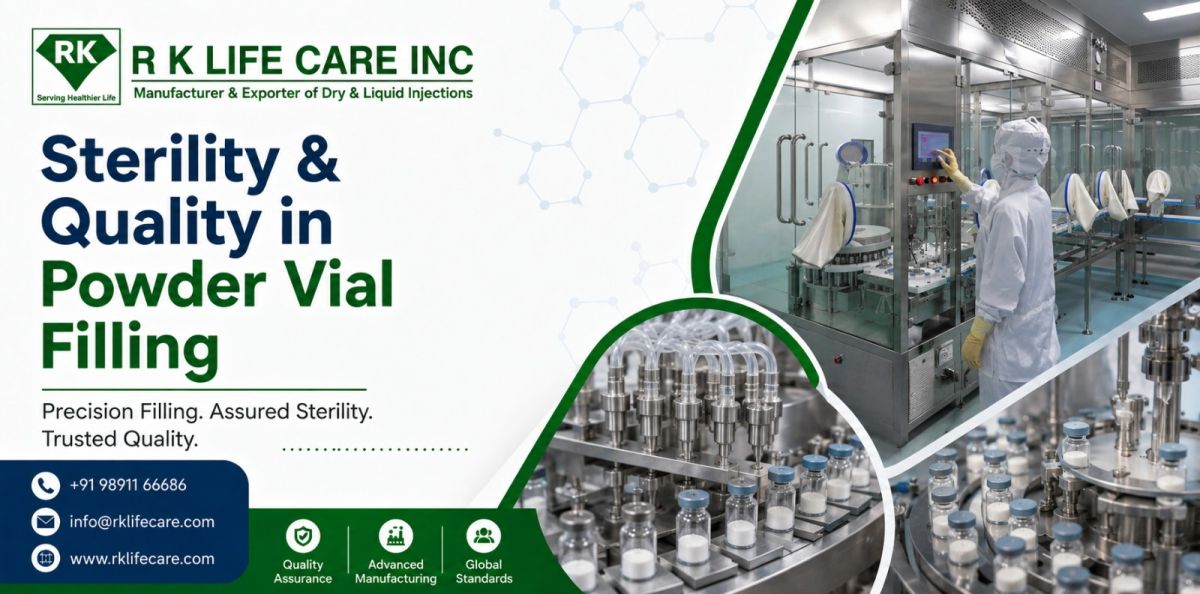
The manufacturing of sterile powder injections stands as one of the most technically demanding and high-stakes processes in the pharmaceutical industry. Because these life-saving medications bypass the body's natural defense barriers and are administered directly into the bloodstream, deep tissue, or cerebrospinal fluid, even microscopic contamination can result in severe clinical consequences. Maintaining absolute sterility, container closure integrity, and flawless quality assurance during sterile powder vial filling is not merely a regulatory obligation—it is a foundational commitment to patient safety and clinical efficacy.
Advanced manufacturing facilities, such as the WHO-GMP and ISO-certified plant operated by RK Life Care Inc in Jhajjar, Haryana, utilize sophisticated clean-room engineering controls, stringent environmental monitoring, and exhaustive quality protocols to ensure every single vial meets the highest purity standards for domestic and international healthcare markets.
The Critical Nature of Sterile Powder Filling
Unlike liquid injectables that can sometimes undergo terminal sterilization (such as autoclaving inside their final sealed containers), many active pharmaceutical ingredients (APIs), critical care antibiotics, and biologics are highly thermolabile. Exposing these complex molecular structures to high thermal energy during manufacturing causes immediate degradation, destroying their therapeutic properties.
Instead, these medications are processed as dry powders through sterile synthesis or lyophilization (freeze-drying) and must be transferred into containers under uncompromising aseptic conditions. This process, known as aseptic powder filling, requires isolating the product from human operators, environmental microbes, and particulate matter at every single operational stage.
Engineering Controls for Aseptic Integrity and Barrier Technologies
To prevent microbial ingress, particulate contamination, and cross-contamination during powder handling, modern pharmaceutical facilities rely on sophisticated engineering safeguards and advanced barrier architectures:
-
Clean-Room Classification and HEPA Filtration: Filling suites operate under Grade A laminar airflow hoods housed within high-grade clean-rooms. High-Efficiency Particulate Air (HEPA) and Ultra-Low Penetration Air (ULPA) filters capture 99.97% of airborne particles down to 0.3 microns, ensuring a continuous sweep of sterile air across the critical exposure zone where open vials are filled.
-
RABS vs. Closed Isolator Systems: Modern facilities deploy advanced barrier systems to physically separate human operators from the sterile core:
-
Restricted Access Barrier Systems (RABS): Provide a physical barrier with glove ports, allowing operators to intervene while maintaining a protected environment via continuous positive laminar airflow.
-
Closed Isolator Systems: Completely seal the workspace from the external clean-room environment, using automated material transfer ports and integrated vaporized hydrogen peroxide (VHP) biodecontamination cycles to achieve near-absolute sterility.
-
-
Positive Pressure Differentials: Controlled pressure cascades between adjacent clean rooms ensure that air flows outward from cleaner zones to less clean zones, preventing contaminated ambient air from entering the sterile core during material or personnel transfers.
Key Quality Assurance Protocols in Vial Filling
Ensuring comprehensive quality extends far beyond the physical clean-room environment. A robust Quality Assurance (QA) framework governs every phase of the sterile powder filling workflow to catch potential deviations before product release:
-
Media-Fill Validations (Process Simulation): Before commercial production batches are executed, facilities conduct rigorous media fills (aseptic process simulations) using sterile nutrient broth instead of drug powder. This simulates the entire filling and stoppering process over extended operational shifts to verify that operators, equipment, and environment consistently maintain absolute sterility.
-
Container Closure Integrity Testing (CCIT): A sterile powder vial is only as reliable as its seal. Advanced CCIT protocols—including dye penetration tests, high-voltage leak detection (HVLD), and microbial immersion challenges—ensure that rubber stoppers and aluminum flip-off seals provide a hermetic barrier against moisture, air, and microbial ingress throughout the product lifecycle.
-
In-Process Quality Controls (IPQC): Automated check-weighers, optical sensors, and laser verification systems monitor fill-weight uniformity, powder distribution, and stopper placement in real time, rejecting any out-of-specification vials instantly from the production line.
Regulatory Standards and Testing Parameters
Compliance with global pharmacopoeial standards dictates that every production batch undergoes extensive laboratory testing before commercial release:
-
Sterility Testing: Batches are incubated in specialized growth media over designated periods to confirm the complete absence of viable bacteria or fungi.
-
Bacterial Endotoxin Testing (LAL Test): Even if a product is completely sterile, the presence of cell-wall debris from Gram-negative bacteria (pyrogens) can cause dangerous fever responses in patients. Limulus Amebocyte Lysate (LAL) assays verify that pyrogen levels remain well below strict safety thresholds.
-
Residual Moisture Analysis: For dry powder and lyophilized injections, precise moisture control is essential to prevent chemical degradation and hydrolysis. Advanced analytical testing ensures residual moisture stays within tight limits, safeguarding shelf-life stability.
Quality and Precision at RK Life Care Inc
Navigating the technical complexities of sterile powder processing requires specialized infrastructure, skilled personnel, and uncompromising adherence to international standards. Headquartered in Rohini, New Delhi, with an advanced manufacturing and research unit in the Reliance Modern Industrial Area (MET) of Jhajjar, Haryana, RK Life Care Inc implements rigorous quality frameworks across its entire production lifecycle.
The organization's manufacturing approach integrates:
-
Certified Compliance: Strict adherence to WHO-GMP, ISO, and GLP guidelines, supporting critical care, anti-infectives, and specialty formulations distributed across more than 20 countries.
-
Advanced Machinery: State-of-the-art automated vial washing, depyrogenation tunnels, and sterile powder filling lines equipped with advanced barrier technologies that minimize human intervention and maximize batch uniformity.
-
End-to-End Testing: Meticulous in-house testing protocols—ranging from particulate matter inspection and sterility verification to comprehensive stability studies—protecting public health and medical safety globally.
Conclusion
Ensuring sterility and quality assurance in sterile powder vial filling is a multi-layered discipline combining advanced clean-room engineering, precise environmental monitoring, and exhaustive laboratory testing. As modern healthcare demands increasingly complex and temperature-sensitive critical care formulations, the reliance on certified manufacturing experts remains paramount. By upholding uncompromising quality standards from raw material entry to final container sealing, industry leaders continue to deliver safe, reliable, and life-saving medications to patients worldwide.
To learn more about our sterile manufacturing capabilities, quality protocols, or contract manufacturing partnerships, connect with the team at RK Life Care Inc today.
Comments
No comments yet. Be the first to share your thoughts!
Leave a Comment